Sunday, March 4, 2012

Ya Mon!

Seven Mile Beach, Negril
Hello friends!  It's been a while since my last post.  February got a little crazy I guess and then I was off on vacation, from which I recently returned.  Warm winter vacations are always fraught with mixed emotion.  I am grateful and happy to have the resources to take a fabulous caribbean vacation, and sad to have to come home and find it is still winter in Wisconsin.  ;)


For many people a mid-winter vacation to the tropics conjures up visions of extravagant resorts with all-you-can eat buffets and bottomless umbrella drinks.  Though I've stayed at places like this in the past, it's no longer our style of travel.  Don't get me wrong...I'm not judging anyone else's choice to vacation in this way.  I have had wonderful carefree getaways at places like these, but over time my desire has grown for less extravagance in exchange for more experience and culture.

My husband and I were married in Jamaica almost 10 years ago (I can't hardly believe it's been that long already!) and it has become a favorite destination.  We were married in Ocho Rios (at one of those extravagant resorts) but have since fallen in love with Negril.  Though it is a popular tourist destination, it is loaded with opportunities to take in the culture of the area.  What do we love so much about Jamaica, aside from the obvious?  The people and the food.

Just like anywhere in the world you will find unsavory people who do not have your best interest at heart, but overall we have found the people of Jamaica to be warm, friendly, helpful and happy to tell you about their lives and homeland.  They are not a wealthy people and do rely heavily on our tourism dollars.  In tourist areas you will be approached to buy everything from bracelets to mind altering substances.  Kindness and respect on your part always goes a long way.  No matter what your struggles at home, if you find yourself on a beautiful beach in a far off place being asked to buy a tchotchke, you definitely have more money than the person trying to sell you something.  Not that you have to buy the bauble, or anything else for that matter, it's just important to keep a little humility in mind.  We serve ourselves and our nation well by being good ambassadors when we travel.

Blue Cave Castle
In all of our travels, Negril is the only place to which we have returned repeatedly.  We choose to stay at a smaller quirky hotel on the cliffs called the Blue Cave Castle.  Though our hotel recently opened a small restaurant on the grounds, we enjoy "foraging" for our own food every day, which puts us in a position to meet local people and make new friends.


The "dairy" case at the grocery store


Jamaica has not been immune to the detriments of our western diet.  Their traditionally natural food system has been infiltrated with the same highly processed food like substances that we over consume in our country.  There are however many people who hold on to the natural food values shared by the Slow Food community throughout the world.  I'd like to introduce you to a few that I've met.


Ras Rody is a Rastafarian with a shack food stand that he refers to as a cultural center.  This from his website:
 I use my stand as a media to educate people about the culture, about where we came from, where we are, and where we are headed.  
I love his story and his world/food view.  The Rastafarian way of life and Ital style of cooking is very interesting and I encourage you to read more about them.  Ras Rody lived "slow food" before it became a movement.  I was disappointed to not meet him when we stopped by his stand for lunch but we were delighted to meet his son Shadrock.  Ras Rody raised his children to embrace his same passion for how our food choices effect the world.  As someone who is passionate about living a slow food lifestyle, it was a joy to have the opportunity to dine and chat with Shadrock.  He cooked us a fabulous vegan lunch with ingredients grown in their own garden or procured from other local sources. We dined on Red Peas (beans) & Pumpkin Soup and a medley of five dishes: Brown Rice & Pumpkin, Curried Ackee, Steamed Callaloo (Jamaica's favorite leafy green), Mixed Veggie Stew, and Curried TVP & Pumpkin Stew.  All washed down with fresh carrot, pineapple, ginger juice.  Fresh, healthy, and delicious!  Ras Rody's food stand is on the West End Rd across from the Tensing Pen resort and is open most every day for lunch.

Shadrock cooking up lunch


Bentley

 
Bentley of Bentley's Crab House.  We met Bentley a couple of years ago while at the small grocery store across the street from our hotel.  He was dressed in his re-sale chef coat shopping for a few essentials and started up a conversation with us complete with a passionate invitation that we come join him for a homemade crab dinner.  We took a chance and discovered a hidden gem in both Bentley and his food.  To say Bentley is passionate about cooking crabs would be an understatement.  He is a joy to talk to and he cooked us up the best meal of our trip.  This time around we made a point of going to see him to arrange for another fabulous lunch.  Bentley was born and raised in Negril where his father was a fisherman and his family farmed and lived off the land.  He started cooking when he was 8 years old and is now a self described "crab man".  Bentley gets up at 3 a.m. to go "fishing" for blue crabs in a nearby river. His sign advertises that he makes the famous Maryland Crabcakes, but his actual favorite way to serve the crabs is to remove the backs, make a seasoned mixture of the meat, and then bake the mixture inside the shells.  You won't find any breadcrumbs here.  The crabs are small in size but they are filled with nothing but meat and seasoning.  Alongside the baked crabs guests are treated to his delicious "sweet" rice (reminiscent of saffron rice and likely made using coconut milk), steamed local green beans and carrots topped with his secret "Magic Sauce", and another vegetable side....this time it was buttery sautéed cabbage, onions, callaloo, tomatoes, garlic, and oregano.  Bentley also treated us an amazing cocktail of hand squeezed Mango & Papaya juice.  Bentley is located off the beaten path on Pee Wee Ln (though the road sign actually says Ella Ln) on the West End.  Pee Wee Ln is near Pee Wee's bar, not surprisingly.  His tiny restaurant/home is built on a hillside, so along with your delicious meal and delightful conversation you get a view of the tree tops and sea.  It is best if you call him ahead, or stop by, to make a reservation so he can be prepared for you.


Bentley's famous crab dinner
Chef Teddy
Teddy's Lobster Thermador
Teddy's Hideaway is located at the Blue Cave Castle.  I spent a lot of time with Teddy in his kitchen a couple of years ago and had a lot of fun.   He makes the best Lobster Thermador (made with locally fished spiny lobsters) and Seafood Curry (Old Time Cooley Sin-Ting on the menu).  He serves up a mean "Jamaican" breakfast (Ackee & salt fish, callaloo, and johnny cakes) and he indulges my special requests to make a Jamaican staple breakfast cereal...cornmeal porridge.  He is open for breakfast and dinner daily on the West End.


Miss Millie
Miss Millie.  This beautiful woman is as bright and cheerful as the juice she makes.  I look forward to seeing her on every visit.  She lives in a small colorful house across the street from our hotel where she makes fresh squeezed juices that she sells in empty booze bottles. Recycling to boot! ;)  Orange and pineapple are her usual offerings.  We stock up at the beginning of our trip to enjoy for breakfast.  Ok, who am I kidding...we stock up on spiced rum along with her juice and mix our own cocktails!
Millie's juice
The patties!  Oh Jamaican patties, how I love thee!  It seems nearly every tropical culture has its own version of stuffed pocket dough street food. Though inexpensive (and admittedly tasty) mass produced versions can be found on the beach and at convenience stores, my heart belongs to Niah when it comes to patties.  Another Rastafarian with a small beach shack who makes the most delicious "slow" fast food with love while you wait.  His patties are like no other.  They are made from scratch as they are ordered.  By scratch I mean even the dough that Niah keeps in a bowl is made up daily and rolled out for each patty as it's ordered to be filled with whatever you choose and then fried in his pots over hot coals.  The fillings are made of easily identified fresh food and the portions measure up to our American oversized standards.  My favorite is the chicken and vegetable patty, which you can ask him to custom make.  Niah doesn't serve beverages, so bring one with you or take your patty to the nearest bar and wash it down with a Red Stripe.
Niah's stand
Niah
Niah's Chicken & Veggie Patty


As you sit and soak up the sun, there is no shortage of fresh fruit, coconut, sugar cane, and other snacks being sold by wonderful people on the beach. The ladies carry their baskets of fruit on their heads up and down the beach and there is one lady who even sings as she goes along.  My favorite snacks are definitely the fresh coconut and sugar cane.  Buy a coconut and the nice lady will impressively cut off the top with a small machete so you can drink down the very nutritious water inside.  Then she'll remove the husk and cut the coconut up in to manageable pieces for snacking throughout the day.  Coconut is rich in healthy medium chain fatty acids and fiber, so this is one snack you won't have to feel guilty about!  Sugar cane is mother nature's answer for a sweet tooth.  I LOVE this stuff.  The cane is peeled and cut in to manageable sticks that you chew and suck on to release the sweet juice contained therein.


Sugar Cane
Fresh coconut
Gary & me

Finally, I have to give a shout out to Gary the lifeguard/handy man at Mariner's Negril Beach Club.  He hooked me up with two bags of the best candy on the planet (which he makes himself)...coconut drops.  I discovered these ridiculous treats on our trip a couple of years ago and haven't been able to get them off my mind.  He said next time we come he'll show me how to make them.  They are diced coconut that has been simmered in water with fresh ginger then mixed with brown sugar and boiled to the appropriate candy temperature.  They look a little like brown sugar-coconut hay stacks and they are very difficult to stop eating.

coconut drop


So as not to go on and on, let me say that Just Natural and Sweet Spot are also worth your time and money for authentic delicious Jamaican fare. Any time you walk in to a restaurant and it is filled with locals, you know you're in the right place.  One notable observation, and perhaps you noticed this yourselves, but I am always amazed at the food these folks are able to turn out of their tiny kitchens with minimal resources.  No Wolff or Viking ranges, giant grill tops, or fancy stainless steel cookware.  Sometimes only hot coals beneath iron grates and well worn aluminum pans. It is clear that all of these folks love on the world around them through their food.

Ras Rody came out with a cookbook this year, which I eagerly purchased.  My meals there inspired me to eat more on the vegetable end of the food chain when I returned home.  Here is my adaptation of the first dish I made from Ras Rody's cookbook and really enjoyed.  It's perfect for our winter weather and yet one more way to use up that storage squash and celeriac.

Lentil Soup
1 C. green lentils
4 C. chicken stock
2 C. coconut milk
1 C. water
2 carrots-small diced
1/2 bulb celery root (also known as celeriac)- peeled, small diced
1 small winter squash-seeded, peeled, and large diced
1 sweet potato-peeled and large diced (you could skip this and just use a larger squash)
1 small bulb garlic
3 sprigs fresh oregano or 1 tsp dried
1/4 scotch bonnet pepper-minced, or a healthy dash of your favorite hot sauce
1 tsp coconut oil-melted (I am falling hard and fast for coconut oil and find myself using it more and more)

1.  Remove loose dried garlic skins from bulb by gently rubbing with your hands.  Tighter skins will remain intact.  Slice top 1/4 inch off bulb to just shave off tips of cloves.  Place garlic in aluminum foil with coconut oil and roast at 275 degrees for one hour or until garlic is soft and fragrant.

2.  Bring stock, coconut milk, and water to a boil in large pot.  Add carrots, celery root, oregano, and lentils to pot, reduce heat and simmer for one hour.

3.  When garlic is ready squeeze soft roasted garlic from skins and add to pot.  Add squash and sweet potato at this time too.  Continue to simmer another hour or so until vegetables are soft.  Remove from heat.

4.  Add minced pepper or hot sauce before serving.  It is suggested you enjoy with sweet festival bread.  I served mine with some brown rice.

This recipe made a large batch (8 servings or so).  I froze what I couldn't eat in a few days in single serve containers.

*Ital cooking excludes the use of salt.  Feel free to season to your taste.

green lentils


Friday, February 3, 2012

The Eggs Have It!

I'll give you fair warning.  I'm about to get on a soap box.  I'll try to keep it brief as this is something I'm fiercely passionate about.   "You are what you eat" is one of my favorite quotes and one which I firmly believe to be true.  It is also the simplest guideline we can follow when making choices about how we choose to feed ourselves.  If we eat artificially enhanced processed food like substances comprised of items we can't pronounce, we can expect that our bodies and minds will notice.  I also believe that this adage applies to the animals and plants we consume.  Why wouldn't it?  Doesn't it stand to reason that if the quality of what we eat affects us, the quality of what our food "eats" affects it?  If we consume vegetables grown in nutritionally deficient soil and supplemented with chemicals...what do you think we're going to consume when we eat those vegetables?   And how about the animals we eat?  Their bodies work much the same as ours.  If they eat nutrient deficient food and are pumped full of chemicals, what are we getting when we consume them?  Get my drift?

There is much research being done in this area as the ideals and terms once used to describe real food...organic, natural, free range, etc are being distorted and abused in an effort to keep us confused and to allow the corporations that control our food system to continue to get rich at the detriment of our physical, mental, and environmental good health.  Unfortunately, you can't always believe what you read on food labels and packaging.  It falls on our shoulders to use our own good sense as our guide. (A fun and enlightening resource is Michael Pollan's latest book, "Food Rules".)

One of my favorite examples in support of "we are what we eat" is eggs.   In 2007, Mother Earth News published a great article comparing the nutritional content of conventional versus pastured organic eggs.  A quick summation reads:
Our testing has found that, compared to official U.S. Department of Agriculture (USDA) nutrient data for commercial eggs, eggs from hens raised on pasture may contain:
• 1⁄3 less cholesterol• 1⁄4 less saturated fat• 2⁄3 more vitamin A• 2 times more omega-3 fatty acids• 3 times more vitamin E• 7 times more beta carotene 4 to 6 times as much vitamin D 

If you have always operated under the idea that eggs are evil cholesterol ridden foods to be consumed in only the most restricted moderation, please read their article (and others like it) and go on to make better choices in your food selection so that you can once again enjoy these delicious, nutrient packed power houses.


Now for some fun!  With all of the warm weather we've had this winter I am hearing from my friends with chickens that it has been a banner winter for their egg production.  Typically with the shorter daylight and cold temperatures chickens lay fewer eggs during the winter.  These fun creatures are very much affected by temperature and daylight...just like we are!  I am fortunate to have a good friend who raises some of the happiest chickens I know.  These beautiful birds, when not in their spacious coop, are allowed to roam their country yard scratching and scavenging for bugs and whatever else they decide to eat.  Their diet is also fortified with wonderful kitchen scraps and garden waste.  These birds eat very well and it shows in the gorgeous eggs they produce.  I am always so excited to get eggs from my friend when she has some to share.  They are full of flavor, the whites are thick and sturdy, and the yolks are the prettiest golden orange I've ever seen.  Sensory evidence of how the quality of these chicken's diet affect the quality of their eggs.


My friend said her hens are producing like crazy and recently brought me 5 dozen of her amazing eggs.  I felt like I won the lottery!  I knew exactly what I was going to do with them...make pickled eggs!  Pickled eggs (also known as Tavern Eggs) are a delicacy in our great state and are most often found on the back bars of small town taverns.  Pickling is a great way to preserve many types of food, and eggs are no exception.  If you have often looked at those hazy jars with skepticism and if you've never tried a pickled egg, I challenge you to give them a try.  If you like salty, vinegary snacks, you will love these!  Pickled eggs make a handy, healthy, protein packed, delicious snack option for big and little appetites alike...particularlly if you get your eggs from a reputable farmer/egg producer. If you're not sure about the source of the eggs you're buying or the conditions in which they were produced, then ask. If the farmer, producer, or grocery store employee doesn't know or won't tell you, then you have the choice to go elsewhere. Again, the onus of our food choices falls on us. Sorry, climbing back up on my box aren't I?

My egg friend turned me on to a fun blog, Mother's Kitchen, that offers a fabulous pickled egg recipe and a new technique for hard cooking your eggs...steaming! As many of you know, the fresher the eggs, the harder they can be to peel.  It's a function of the air cell inside the egg and pH of the proteins. I usually ask my egg friend or farmers for their older eggs when I know I'm planning to hard cook them. Mother's Kitchen suggests the steaming technique she uses avoids the peeling issue no matter how fresh the eggs are. I look forward to testing this myself over time to see if I have the same luck.

Two dozen luscious eggs!


Finished product!


Hot pickled peppers I used from my pantry.


The eggs I used for this pickling were 3-4 weeks old.  The recipe was a snap to make and after sitting in my refrigerator for a minimum of 3 days, the results are delicious!  I've been eating the eggs (always with some pieces of pickled onion, pepper, and garlic from the jar) for breakfast with toast and sautéed spinach, on salads, mashed for egg salad, and just by themselves.  I would imagine they would be fantastic in a winter potato salad or mixed with some canned sardines or tuna! These eggs will be safe to eat for weeks to come, but I don't think they'll last that long.

Sliced pickled egg, garlic sautéed winter spinach, Silly Yak Dakota toast. 

Harvesting the bounty that Mother Nature gives us, in the condition it was intended, is good common sense.  Finding ways to preserve that bounty so it can be enjoyed longer or used at a later date can be a little tricky, but is often much easier than we think.  Real food offers us the best option for better health, better economics, and it just plain tastes better.

If you need some help finding farm fresh eggs here are a few ideas:
1. Get to know your neighbors.  More and more people are raising their own backyard chickens right in the middle of your city.  If your commute takes you outside the city limits keep your eyes open for farms with "eggs for sale" signs.

2. Check out your local farmer's market and talk to the farmers there to decide whose eggs you'd like to buy.  In Madison, our Dane County Farmer's Market runs year round (on Saturdays)

3.  Pasture Patterns offers an egg CSA (as do other farmer's) and they also offer their eggs in some local retail outlets.

4. Ruegsegger Farms sells their eggs through their Paoli Local Foods grocery store and they are currently offering a sale due to the abundance of their winter eggs!  (If you can't access the Facebook link, give the store a call to ask about the special....it's while the supply lasts!)

Sunday, January 29, 2012

Winter Squash: A Study in Still Life Part III

Well, here it is.  The final installment of my winter squash series.  Have you had enough?  I still have a few squashes waiting patiently in my basement for their turn to play a role on our dining table.   Winter in Wisconsin can become a little tiresome, in more ways than one.  I am grateful for the beautiful and nutritious abundance that winter squash provides us.  Finding ways to get creative with this vegetable is important to help us enjoy all it has to offer through our long winter months.  (If you have had enough of squash and aren't interested in more inspiration, please skip to the end of this post for other important information.)


The recipe I want to share is adapted from "One Bite at a Time - Nourishing Recipes for Cancer Survivors and Their Families" by Rebecca Katz.  Rebecca is a nationally recognized expert in using food as medicine.   Her book is inspiring and filled with recipes that are beneficial for everyone.  What I love about this recipe is not only that it is balanced and healthy, but also that it is extremely versatile and can be easily adapted according to what you have available in your pantry and what is in season.

Seasonal Couscous


Squash:
1/4 tsp ground cumin
1/4 tsp ground coriander
1/4 tsp sea salt
1/8 tsp ground cinnamon
2 Tbls olive oil
2 C. peeled and diced acorn squash, butternut squash, sweet potato, or a combination


Couscous:
1 C. couscous
1 Tbls olive oil
1 Tbls diced shallot
3 Tbls diced fennel
1/2 C. dried cranberries, currants, or a combination
pinch of red pepper flakes
1/4 tsp ground cumin
1/4 tsp ground coriander
1/4 tsp sea salt


To make the squash, preheat the oven to 350 degrees.


In a large bowl, mix the cumin, coriander, salt, cinnamon, and olive oil.  Toss the diced squash in the mixture to coat well.  Roast on a rimmed sheet pan for 15 minutes, or until just tender, shaking the pan once so the squash cooks evenly.  Remove from the oven, cool, and set aside.


To make the couscous, combine the couscous and 1 C. boiling water in a large bowl and immediately cover tightly with a lid.  Let it sit for 10-15 minutes, or until the moisture is absorbed.  Place the couscous on a sheet pan and spread it out with a fork, raking several times while cooling to keep the grains from clumping.


While the couscous is cooling, heat the olive oil in a large sauté pan.  Add the shallot and fennel and cook until soft.  Add the dried cranberries, red pepper flakes, cumin, coriander, and salt.  Stir well.


When the couscous has cooled, add the shallot mixture and squash.  Stir well and add a squeeze of lemon juice if desired.


Serve at room temperature.


Serves 4.


As I mentioned above, this recipe lends itself well to your creativity.  Couscous is a nutritious alternative to pasta and rice but if you want even more nutrition use Quinoa instead of couscous.  Quinoa (pronounced "Keen-wah") are edible seeds from an ancient grass.  It originates from South America and was a sacred crop of the Incas.  Quinoa is chock full of essential amino acids, making it a complete protein, one of few in the plant kingdom.  It is also high in fiber, minerals, and it is gluten free.  Kind of a wonder food really!  Quinoa is light and fluffy when cooked and its mild and slightly nutty flavor makes it a healthy substitute for white rice or couscous.  You can find Quinoa readily in any grocery store.  Simply follow the directions on the box to cook and then substitute for the cooked couscous in the recipe above.

Couscous
Red Quinoa


Nuts are a great addition to this dish as well.  You can buy black walnuts and hickory nuts locally from our farmer's markets, or harvest your own.  Pistachios, almonds, and pine nuts also make a great addition.  Be sure to toast the nuts before adding them to your dish for better flavor.

Toasting nuts:  heat dry skillet (skillet should be large enough to accommodate nuts in a single layer) over medium-high heat, add nuts, toast the nuts shaking the pan often to toast evenly.  This takes only a few minutes and the nuts can burn quickly, so do not walk away from the stove while doing this.  When nuts are lightly browned and fragrant remove from heat and skillet to stop cooking.  

Other ideas:  If you don't have shallots you can use onion and garlic.  In the spring try adding asparagus and fresh sauté greens to the mix.  Through the summer use zucchini and summer squashes instead of winter squash and toss in cherry tomatoes.  Try playing with fresh herbs as well.  Fall brings us hearty greens like spinach and kale, leeks, and we start seeing the winter squashes again.  Apples would add a fun sweet tart flavor too.  Don't be afraid to get creative!!  I have occasionally also added some feta or goat cheese and other times a simple vinaigrette.  Vom Fass is a great place to get fun oils and vinegars to brighten up any salad!

If you skipped to the end, here is the important information I was talking about. ;)
Believe it or not our winter farmer's markets are teeming with fresh produce and storage vegetables alike.  Many of our local farmer's now have hoop houses to bring us beautiful spinach and salad greens in the middle of January.  Winter eating in Wisconsin has never been so good!  For those of us who like to grow some of our own food the winter lull is about over and it's time to start our garden planning.  If you are a vegetable or flower gardener don't miss the Garden Expo coming up February 10-12th!  There are experts galore offering their advice and knowledge across a wide range of topics for bargain prices.  If growing your own food just isn't a part of your life, you must consider investing in a CSA.  Most local HMOs now even offer a reimbursement from your health insurance to help cover the cost.   Another jewel of an expo (of sorts) is MACSAC's CSA open house coming up on Sunday, March 18th.  If you have ever been curious about CSAs or are in the market and want to shop your options you should not miss this event!  

I would love to hear what seasonal dishes you are cooking up in your kitchens!  Please post in the comments. :)


Saturday, January 21, 2012

On a Mission

I was recently blessed to be part of a medical mission trip to Mexico.  It was an incredible adventure on many levels... personal, professional, and spiritual.  It was an intense four day excursion with an amazing group of people to do what we could with what we had to bring surgical services to the people of Chiapas (and nearby), Mexico.

Most of our team. Vernon is first lower right.
Our group consisted of three teams of eye surgeons and staff who performed a variety of life changing procedures on children and adults, some of whom traveled as far as 12 hours by bus for the chance to be treated.   Clinica Pena de Horeb (Rock of Horeb Clinic) is a humble facility in Cintalapa, Mexico, where the feeling of a power greater than our own is palpable.  I was nearly moved to tears daily by the incredible work we were able to do with minimal resources and by the sacrifice and appreciation of the people who allow this place to exist and those who came and sat for hours, sometimes a full 24, in the hopes of being seen and treated.  Unfortunately, with each mission campaign there are more patients who arrive than can be treated.  That fact made taking a break and getting a full night of sleep not seem quite so important.  It was a volunteer experience that moved me more than any other and one that I am already looking forward to repeating.

Potential patients waiting in the courtyard
The clinic

The clinic was started in 1991 by Vernon and Grace Odom (a retired couple from Texas) with the help of the non-profit group Good News Friends, Inc. (which they also founded).  I had the pleasure of meeting Vernon on this trip.  He is a quiet and kind Octogenarian who continues to drive from his home in Texas to the clinic in southern Mexico each year.  The clinic has become  known throughout southern Mexico as "the eye clinic" as many medical teams from the U.S. come and do hundreds of eye surgeries each year.


My role on this trip was to provide anesthesia services to some of the children and adults who came for surgery.  Sharing the details of our limited equipment and resources consistently elicits a "wow" and "oh my gosh" from every person with whom I share my story.  We had to think "outside the box" and summon the ingenuity that made McGyver famous.  In comparison, it's clear that we often accomplish so little with so much in the U.S.  The amount of waste in our country in so many facets of our lives is mind boggling.  Especially when you see what you can accomplish with so little at your disposal and to see what so many in this world live without.  I don't really have the words to describe the experience and the impact this trip had on me.  You have to see it for yourself to really understand, and I highly encourage you all to do so.
My anesthesia equipment:  there is no anesthesia machine

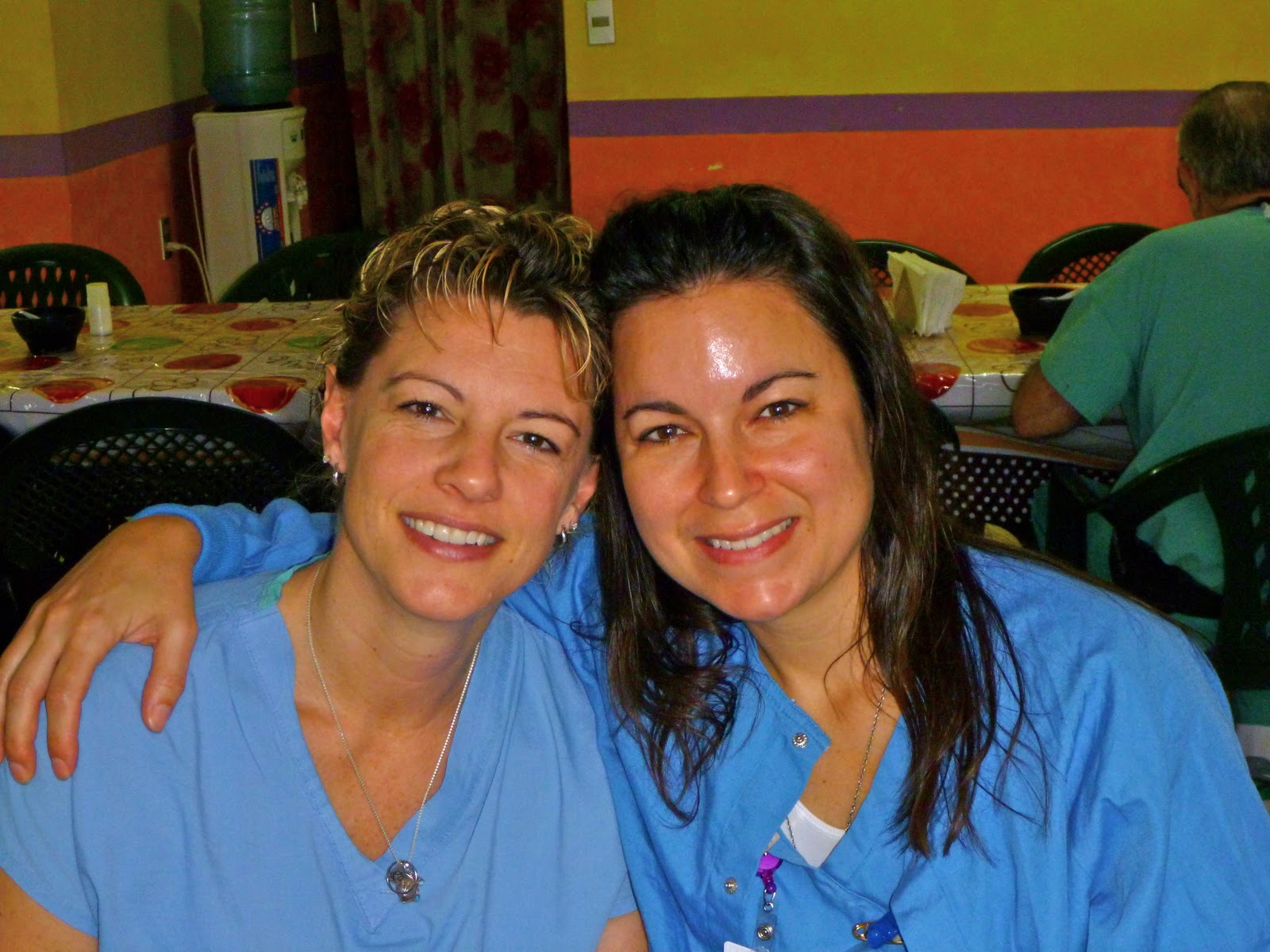
Dr. Mark Lucarelli, Jenny Barett RN, and me


One of my intentions for this blog was to show, through my own life adventures, how food connects us with the world.  The clinic has recently added a beautiful kitchen on to their facility in order to feed the volunteers who come there to work.  It is their way of saying "thank you". And it is the best thanks I could ever hope for.  Though we had just a short time to break for meals during our 18 hour days, the love from the kitchen couldn't be denied.  Three lovely women cooked simple homemade southern Mexican cuisine for us every day.  Their work days were nearly as long as ours and they always had smiles for us when it was meal time.

Our "cocineras" hand shredding banana bark for tamale ties
Fresh corn tortillas, salsa verde, fresh papaya, and guava were served with nearly every meal.  Two outdoor wood fired adobe ovens were used on the first day to cook up chickens (no doubt from the grounds) which would be used as our primary source of protein during our stay.  Our meals consisted of scrambled eggs with salsa, empanadas, chiles rellenos, banana leaf tamales, and chicken & black bean tostadas...all made by hand.  (They even hand shredded the dried banana tree bark that was used to tie the tamales!)
Tostada & Banana leaf tamale

Eggs, potatoes, plantains, fruit


Chiles Rellenos, rice, flan
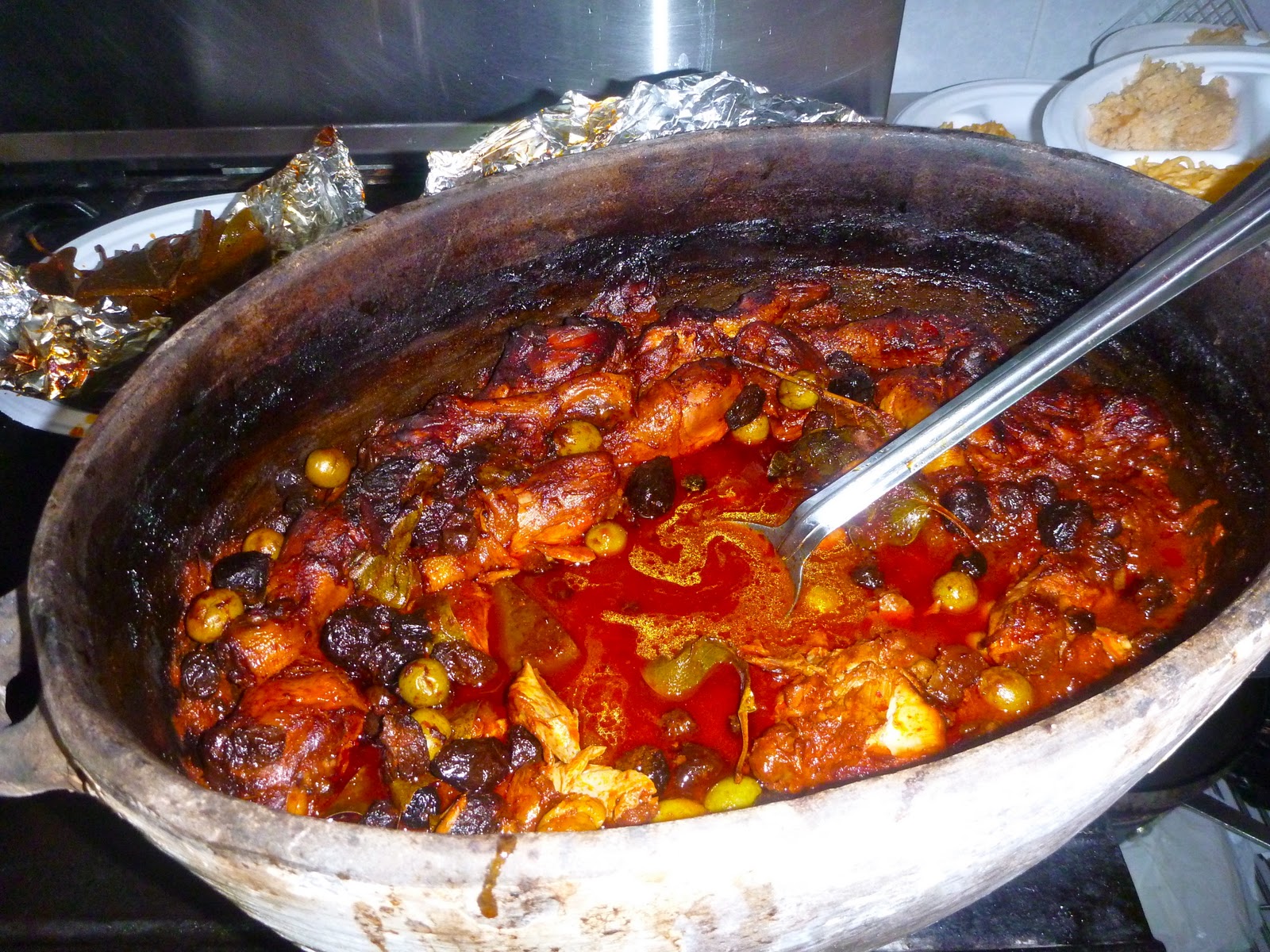
Barbacoa de Pollo


My favorite dish was served at our first lunch.  It was Barbacoa de Pollo and it was delicious!!  I was able to get a list of ingredients from one of our cocineras and subsequently found a similar recipe  online by one of my favorite chefs of Mexican cuisine, Rick Bayless.  Essentially it was chicken legs and thighs stewed for hours in the adobe oven with red wine, red wine vinegar, guajillo and cascabel chilies, dried avocado leaves, garlic, onion, prunes, green olives, cinnamon, and cloves.  I don't see some of these items on chef Bayless's recipe but they really added some fun to the plate and I will add them when I try making this myself.  The meat melted off the bones and the sauce was rich and smoky with a hint of spicy heat.  

When the ladies told me about using Avocado leaves I had to clarify that that is really what they meant.  We were speaking in Spanish after all and perhaps I misunderstood.  As a lover of avocado however, I know full well that "aguacate" is how you say "avocado" in Spanish.  I saw the leaves sitting on the counter and assumed they were some kind of large bay leaf, as that's what they looked like.  I had never heard of cooking with avocado leaves before.  I did a little calling around and found that they can be purchased at some of our local ethnic grocery stores (Yue Wah being one for sure...an adventure in itself!) here in Madison.  

Not only was the food a fun way to connect to the culture in which we found ourselves, but also to the people who live there and to each other.  Our short breaks for meals was the one time during the day when we volunteers could gather in one place to get to know one another, laugh, commiserate, relax, regroup, and reinvigorate.  It allowed us a few short minutes of fresh air as we had to walk outside briefly to get from the operating rooms to the dining room.  It was also a stark reminder of what we were doing and how needed we were.  Our walk to the dining room lead us past the covered courtyard where all of the hopeful potential patients waited (for hours and sometimes days) with empty bellies and dry mouths.  It was a loud and firm reminder to be grateful yet it came in the simplest of ways...a mere few steps taken from one door to another.  Food is so much more than just fuel for our bodies.  It is a bridge that connects us on so many levels to the world around us.

My four short days on this trip were filled with constant simple yet firm reminders to be grateful.  To be grateful that I was born in a country of such abundance, to a family who could offer me so much potential, and who raised me to make the most of that potential. With very few exceptions, we all work hard for what we have, yet we are also so very lucky to have what we have and to be able to work hard for it.  It's so easy to get lost in the constant bombardment of excess in our culture.  I intend to continue to take this trip and take part in other efforts locally to help me maintain my perspective on what is truly important in life.  I can't encourage you enough to find an opportunity to reach out and help someone in need.  It doesn't have to be in another country.  It can be as simple as crossing your street.  You may be blessed in ways you never imagined.
How cute is he?!
New friends with very tired eyes!


P.S. I would be remiss if I didn't tell you that many of the ingredients necessary for the Barbacoa can be found at the winter farmer's market!  Onions, garlic, chicken, and even tortillas! The spices and dried chiles are available at Penzey's and other ingredients can be found at our local ethnic grocery stores.  Food is a bridge between people...don't be intimidated by our ethnic grocery stores, they are exciting places to explore and if you are kind and patient you will likely be treated the same in return.

Thursday, January 5, 2012

Even Mother Nature Loves Bacon!

To kick off the new year, I need to take a break from the squash trilogy and tell you about something a little more exciting.  I made a fun food discovery at the East Side Farmer's Market late in the season last year.  (Seems strange to already refer to 2011 as "last year")  Tonight I took a stab at cooking my new found fun and these little morsels lived up to every expectation.  What are these tasty morsels?  Marrow Fat Beans.

Even if you don't like dried beans, how could you not be intrigued by one named after the most decadent part of an animal?  And as if that weren't enough to get you to try them, how about the promise that Mother Nature gave them the flavor of bacon?  Bacon?!  Beans that taste like BACON?!  These adorable snow white beans were definitely coming home with me.  How this wonderful legume ended up nearly extinct is a mystery to me.   Thanks to Slow Food's Ark of Taste and the folks at Sprouting Acres Farm, the Marrow Fat Bean has been saved from vanishing and is available for us to enjoy.

These beans have been soaked, when they are dry they are bright white.


If you're wondering what the Ark of Taste is, please allow me to introduce you.  The Ark of Taste is a modern day Noah's Ark in the food world.  It was created by Slow Food International in 1996 as a way of bringing attention to and preserving foods in danger of extinction thanks to our current monoculture food industry.  It's a really fun and interesting list that I encourage you to check out. (The U.S. even has their own list...US Slow Food Ark of Taste) I also encourage you to consider growing some of these varieties in your own garden and seeking out others to sample when you have the chance.  One of the best ways to encourage and support diversity in our food system is to create a demand by eating said diverse food!

What follows is my first attempt at cooking my special 1 cup bag of Marrow Fat Beans.  My online search for recipe ideas and information about these beans was pretty lack luster.  A recipe from Human Nature inspired the cassoulet I ended up concocting.  Interestingly enough, the Human Nature folks got their beans from Sprouting Acres Farm as well, and their recipe post was inspired by the Eat Local Challenge put on annually by Willy St Co-op (something I strongly encourage you to try when it comes around again in September 2012)

My "recipe" here is a rough guide for sure, and honestly the way I tend to cook.  The only time I follow a recipe to the letter is when I'm baking.

Marrow Fat Bean Cassoulet

1.  Because I hadn't planned ahead, I started by doing the quick soak method with the beans.  Place beans in a saucepan, cover with water, cover pan with a lid, bring to a boil for 5 minutes, remove from heat and let sit for and hour or so.  Rinse beans and cook according to your recipe.


2.  Since the limited information I found online suggested these beans required an overnight soak and a long slow cooking time, I decided to pull out my pressure cooker to speed things up.  I sautéed some sliced onion, rough chopped carrot, and cloves from an entire bulb of garlic (cloves cut in half lengthwise).

3.  Then I added a package of George's Fresh Kielbasa from Willow Creek Farm, sliced in 2 inch sections, and continued to sauté until everything was lightly browned.  (This sausage is fantastic and deserves it's own blog post.  Be sure to follow the link to read more about it!  Willy Street Co-op occasionally carries it in their meat freezer.)


4.  I added the soaked and rinsed beans, some salt, and a sizable dollop of Basil Pistou (thanks to a suggestion from my friend Jan M., I used this method for preserving my summer supply of basil and parsley...brilliant!)   I also added a light sprinkle from each of my jars of Green Bell pepper, Red Bell & Carmen pepper, and celery powders.  A method I used for preserving my some of my summer bounty by dehydrating my garden peppers and celery, then pulverizing to a coarse powder in my food processor.  These powders have been so handy!!


5.  I covered the whole lot with 8 oz vegetable broth and another cup plus of water.  I cooked the cassoulet in my pressure cooker on high for 18 minutes, then released the pressure using the rapid cold water method.

The initial result was a bit of a soupy mess and I was nearly disappointed.  It turns out the beans don't require quite as much cooking as I had anticipated.  I drained the "soup" reserving the solids to a bowl and putting the liquid back in the pan.  After a quick taste I decided the broth needed a bit of wine, so I added a solid glug or two of a dry white wine I keep in my fridge for cooking.  I brought the liquid to a boil and cooked it uncovered until it was reduced to a nice thick sauce.  I added the sauce back to the solids and voila...dinner was ready!!


The result was a delicious, creamy, soul warming cassoulet with wonderful bursts of flavor from the now fork tender kielbasa.  Now for the million dollar question...did the beans taste like bacon?  I wouldn't say they have the forceful taste of bacon, but they do have a wonderfully distinctive and delicate flavor of smoky ham.  A description of the beans I found suggests they lend themselves well to being pureed.  These beans are definitely the creamiest I've ever tasted.  A piece of crusty sourdough toast and a glass of beer made this a dinner to definitely make again!!

Happy 2012 to you all!!